
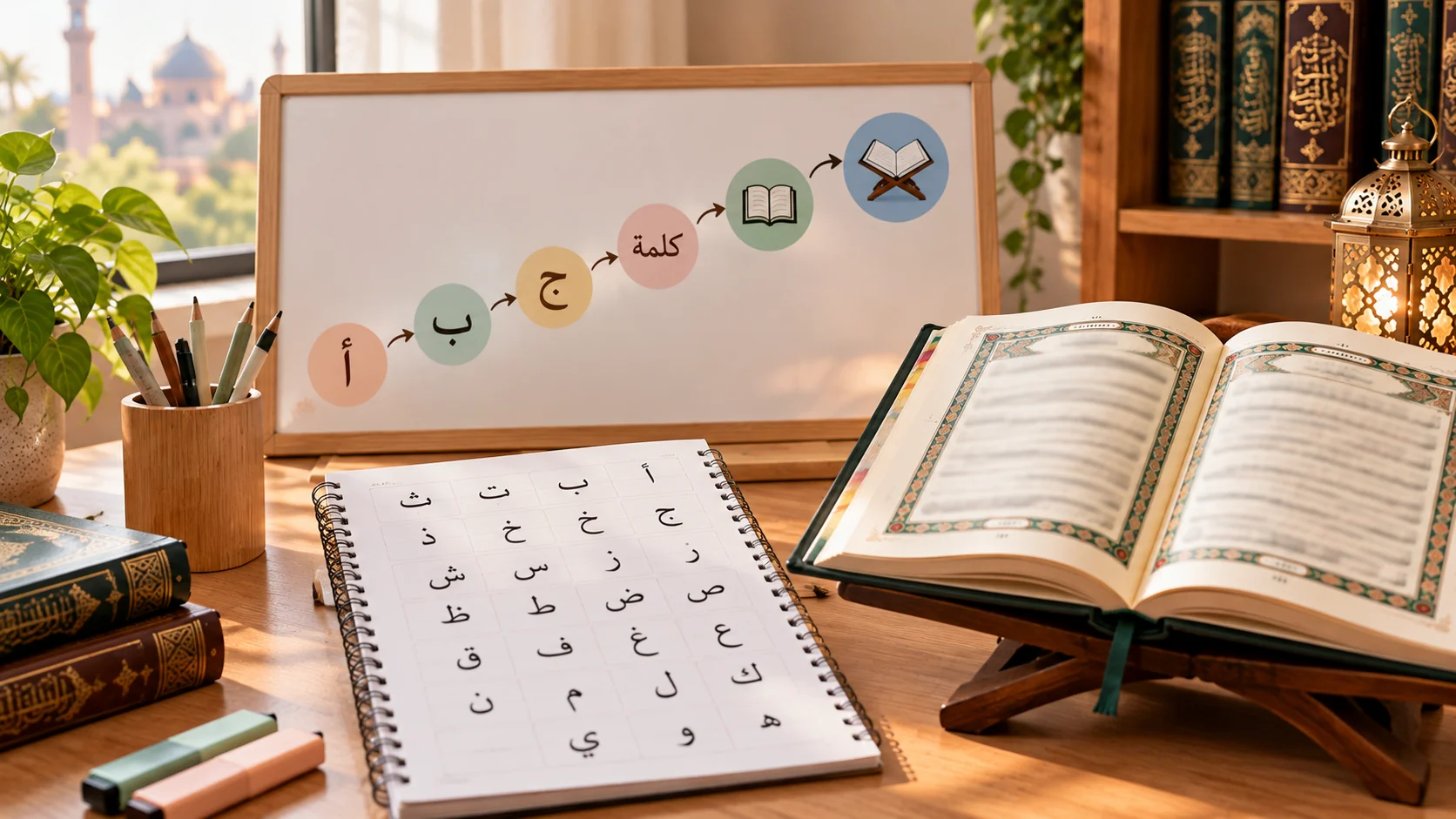
Moving from Arabic letters to Quran reading means learning to recognise sounds in unfamiliar words, not only reciting the alphabet in order. A beginner needs time to connect letter shapes, vowel signs and sounds before longer passages become manageable.
Key Takeaways
- Check letters alone and when joined.
- Practise a small vowel contrast before adding more rules.
- Keep decoding and Quranic vocabulary as separate learning goals.
A teacher may use a Qaida or another foundation text. Ask which material they recommend; the name on the cover matters less than whether the exercises address your current difficulty. The academy offers Quran reading foundations, but a particular textbook should be confirmed directly.
Four milestones to discuss with the teacher
| Skill | A useful check |
|---|---|
| Recognising letters | Can the learner identify a letter without seeing the whole alphabet? |
| Recognising joined forms | Can they find the same letter in a short connected word? |
| Reading vowel signs | Can they change the sound when the vowel changes? |
| Blending sounds | Can they read a new combination instead of recalling a memorised example? |
These checks help locate the next exercise. They are not a demand that every learner move through the same number of lessons.
Use a small example to find the difficulty
Consider بَ، بِ، بُ. The letter stays the same, while the short vowel changes the sound: ba, bi, bu. The Latin spellings are only reminders; they cannot replace hearing and practising the sound with a teacher.
If the learner says the same sound for all three, concentrate on noticing the vowel. If they read each one correctly in isolation but struggle in a word, practise joining sounds. If they confuse the letter itself, return to recognition before adding more signs.
Do not introduce every reading rule in the same exercise. Ask the teacher to select a small contrast and listen to the result. This makes it easier to discover whether the learner understands the step or is following your voice.
What to do at home
Use the teacher’s assigned material and point to one item at a time. Let the learner attempt it before giving the answer. Once an example is familiar, ask the teacher for a new example using the same skill; this checks understanding rather than memory of the page.
For children, stop before a short task turns into an argument. For adults, write down the exact place where reading breaks down. “I lose the vowel when the letters join” gives the teacher something specific to address.
When to begin Quran passages
Ask for a short passage suited to the learner’s current reading, with guidance on pronunciation and any unfamiliar signs. Starting a passage does not mean foundation work is finished. A teacher can return to a letter or reading step while introducing supported Quran reading.
Measure progress by what can be read accurately with less help. Avoid a fixed promise such as “fluency in three months”; learners start with different experience and practice opportunities.
Explore Quran reading and Arabic programs. Our guides to adult beginners and home practice for children explain how to support these steps between lessons.
Check joined letters without guessing
The letter ب has different appearances as it joins other letters: ب، بـ، ـبـ، ـب. These are display forms, not four different letters. A teacher can point to ب at the start of بَاب, the middle of جَبَل, and the end of كَتَبَ. These are ordinary Arabic practice words, not quoted Quran verses. The examples identify letter position; they are not a complete pronunciation lesson.
Try this short check with the teacher:
- Find ب in each word without reading the whole word.
- Point to the vowel over the first letter in بَاب.
- Read كَتَبَ slowly, keeping all three short vowels.
- Ask for a different word using the same letters.
Write the exact difficulty: “I identify ب alone but miss it in the middle of جَبَل.” That gives the next lesson a more precise target than “I need the alphabet again.”
Reading a word and understanding it are separate goals
Reading practice teaches you to recognise the written sounds. Quranic Arabic study also examines vocabulary and meaning in context. Being able to sound out a line does not establish that you understand its meaning. Ask for Arabic reading foundations and Quranic Arabic according to your goal, and use the Quran beginner program for guided reading. Neither Modern Standard Arabic conversation nor Egyptian dialect is assumed to be part of this offer.
Begin with a conversation
Describe which letters or reading steps are difficult and ask the academy about a foundation lesson. Confirm the learning material before the trial.
Editorial ownership and source notes
Prepared by the Wanoyasserka Academy editorial team as a practical learning guide, with AI-assisted drafting. Teaching suggestions and completed notes are illustrative; they are not student results, clinical assessments, or guaranteed course outcomes. Availability and individual arrangements require direct confirmation.
Contact the academy about a correction or enrolment question. Consult the relevant course and package links above for the academy’s stated offer. A learner’s own teacher should check pronunciation exercises before they become a home assignment.
Listen to a letter inside a real word
- Open Al-Fatihah 1:2, enable word-by-word audio in the word settings, and tap ٱلْحَمْدُ. Point to ح inside the word while listening.
- Open Al-Ikhlas 112:1 and tap هُوَ. Locate ه. Compare the two sounds without treating an English “h” as an exact description of both.
- Listen to each complete verse with the verse player. Follow the same word in context rather than guessing from a remembered recording.
- Pause the player, attempt the selected word from the Arabic, and note which letter you need your teacher to hear.
- Keep the isolated بَ، بِ، بُ exercise separate: these are ordinary teaching syllables, not Quran quotations. The linked recordings do not supply that exact drill; ask the teacher to demonstrate its three vowels.
Use the players below to listen on this page. Verse recordings are by Mahmoud Khalil Al-Husary, supplied through Quran.com. The separate word clips come from Quran.com’s word-audio service; its metadata does not name the individual reader. Ask your teacher to check your attempt after listening. The Quran.com guide explains the source site’s word and verse controls.
Play the selected word recordings here
| Word and reference | Word recording | Verse recording |
|---|---|---|
| ٱلْحَمْدُ — 1:2 | Listen to the word | Listen to the verse |
| هُوَ — 112:1 | Listen to the word | Listen to the verse |
Audio provided by Quran.com / Quran Foundation. Verse recordings: Mahmoud Khalil Al-Husary, API recitation 6. The word-audio metadata does not identify its individual reader. Playback is part of this learning page under the Developer Terms; no audio file is bundled with downloads.
Editable practice resources
Listening reference and source
For recitation terminology, consult Salsabil al-Shafi, a commentary on the Jazariyyah. For Arabic word structure, see Quranic Arabic Corpus documentation. Use these as references alongside audible teacher correction.