
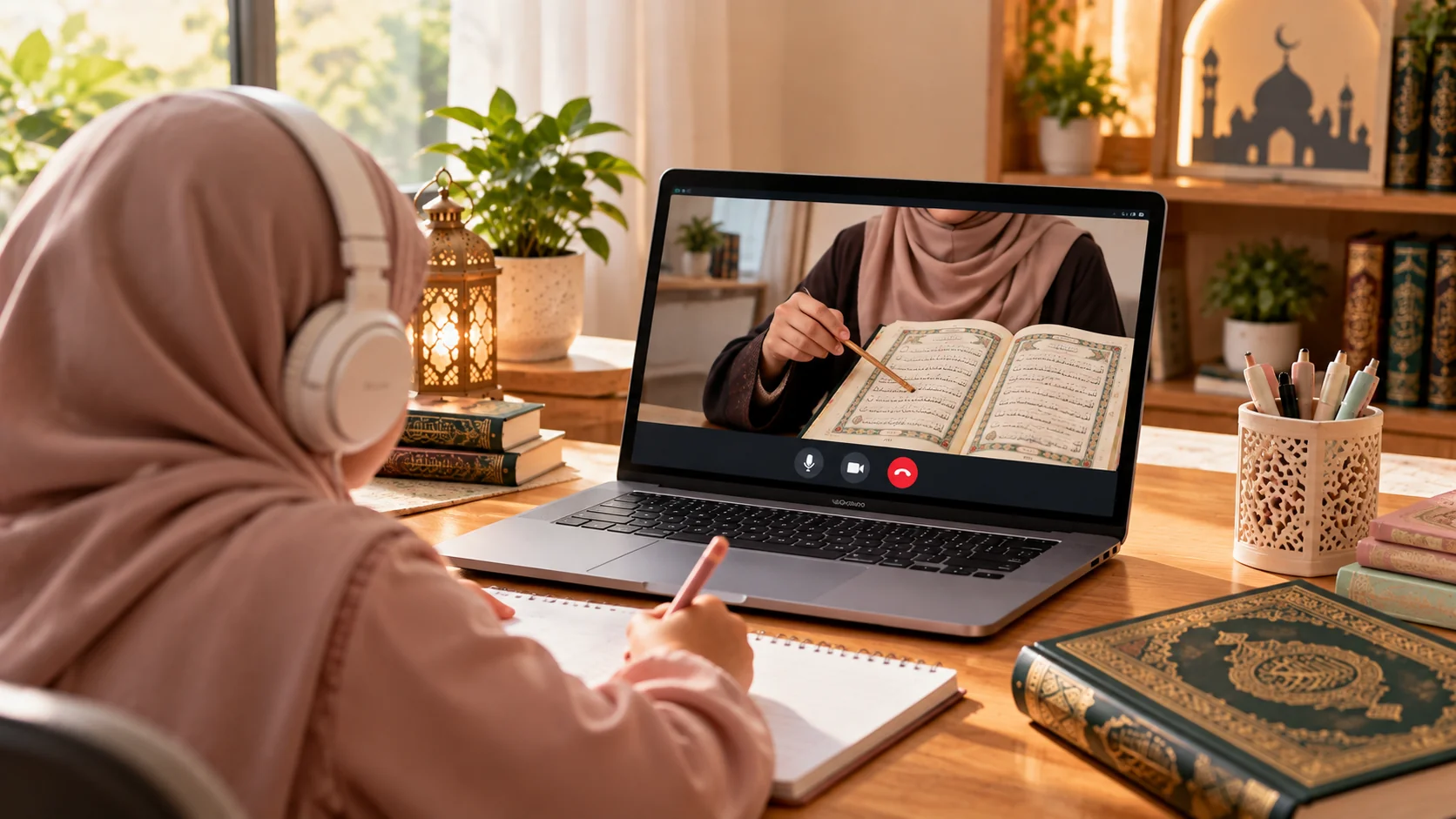
For your first online Quran lesson, prepare three things: working audio, the reading material requested by the academy and a short description of what you want help with. You do not need to improve your reading before the trial. Hearing your current reading helps the teacher choose a starting point.
Key Takeaways
- Test the audio and confirm the requested material.
- Describe one current reading difficulty.
- Leave with a practice task and confirmed next-step arrangements.
Confirm the call platform and access instructions in advance. Do not assume the lesson uses a particular app. Write the appointment in your local time and check it again if either country has recently changed its clocks.
Check the setup before the lesson
Use the device you intend to study on, not a different device just for testing. Open the lesson link, check the microphone and speaker, and put the screen where you can see the teacher and material comfortably. Turn off television or other background audio.
Keep the device charged. If you use headphones, check that their microphone is selected. Ask which book, page or digital text to have ready; different editions can have different page numbers. If the call fails, contact the academy through the agreed channel rather than repeatedly joining with several devices and creating an echo.
A checklist for parents
- Tell the teacher your child’s age and previous learning experience.
- Mention the language your child understands best for explanations.
- Describe a specific difficulty, such as confusing similar letters or losing their place.
- Keep the book and a pencil nearby if requested.
- Stay available to help with the device, especially for younger children.
- Let your child answer and read before offering help.
Avoid a long practice session immediately before the trial. A tired child may find it harder to concentrate. Introduce the lesson as a chance to meet the teacher and find the right starting point, rather than a test they must pass.
A checklist for adults
Tell the teacher whether you are starting with letters, returning after a break or reading with pronunciation difficulties. Mention which explanations you prefer in Arabic or English. If reading aloud feels uncomfortable, say that at the beginning; you can ask to start with a short, familiar passage.
Bring one clear question. For example: “I can follow a recording, but I cannot read the same passage independently. Where should I start?” This helps distinguish familiarity with a passage from independent reading.
What to ask before the call ends
A useful outcome is knowing your next step, even if you have not covered much material. Ask:
- What should I practise before the next lesson?
- Which material should I use?
- What level or program do you suggest, and why?
- Which lesson times and teacher options are available?
- Where can I confirm the package and missed-lesson arrangements?
The academy offers one free trial lesson. Confirm the available time and lesson arrangement directly. See the learning programs and compare packages before choosing a continuing plan.
If you are arranging lessons for a child, our teacher-selection checklist explains what to observe during the trial. Adults can use the beginner starting guide to prepare questions about their level.
An illustrative lesson sequence
The actual trial depends on the teacher and learner. This sequence is an example to discuss, not a confirmed academy timetable:
| Stage | Useful outcome |
|---|---|
| Agree on the goal | The teacher understands the starting difficulty |
| Attempt a short exercise | The teacher hears independent reading |
| Practise one correction | The learner understands what to change |
| Agree on a next step | The family knows the material and practice task |
| Confirm arrangements | Available days, duration and price are clarified |
For example, a learner may begin by identifying letters rather than reading a surah. Another may read a familiar line and work on one recurring correction. Neither needs to finish a chapter for the trial to be useful.
Save a note immediately afterwards
Copy this record while the instructions are fresh:
- My starting exercise: _____
- One thing I can attempt independently: _____
- Correction demonstrated: _____
- Home practice and material: _____
- Remaining scheduling or payment question: _____
Illustrative completed note: “Starting exercise: joined-letter reading. Independent task: identify the first letter. Practice: repeat the teacher’s assigned combination. Remaining question: confirm Tuesday’s appointment in my city.” It is a model, not a report of an actual lesson.
If you are new to Islam, the new-Muslim starting guide separates reading goals from other religious questions. Select beginner lessons or children’s lessons according to the learner.
Begin with a conversation
Ask the academy to confirm a trial time, the call instructions and the material to prepare. Include your city so you can agree on the appointment in your local time.
Editorial ownership and source notes
Prepared by the Wanoyasserka Academy editorial team as a practical learning guide, with AI-assisted drafting. Teaching suggestions and completed notes are illustrative; they are not student results, clinical assessments, or guaranteed course outcomes. Availability and individual arrangements require direct confirmation.
Contact the academy about a correction or enrolment question. Consult the relevant course and package links above for the academy’s stated offer. A learner’s own teacher should check pronunciation exercises before they become a home assignment.