
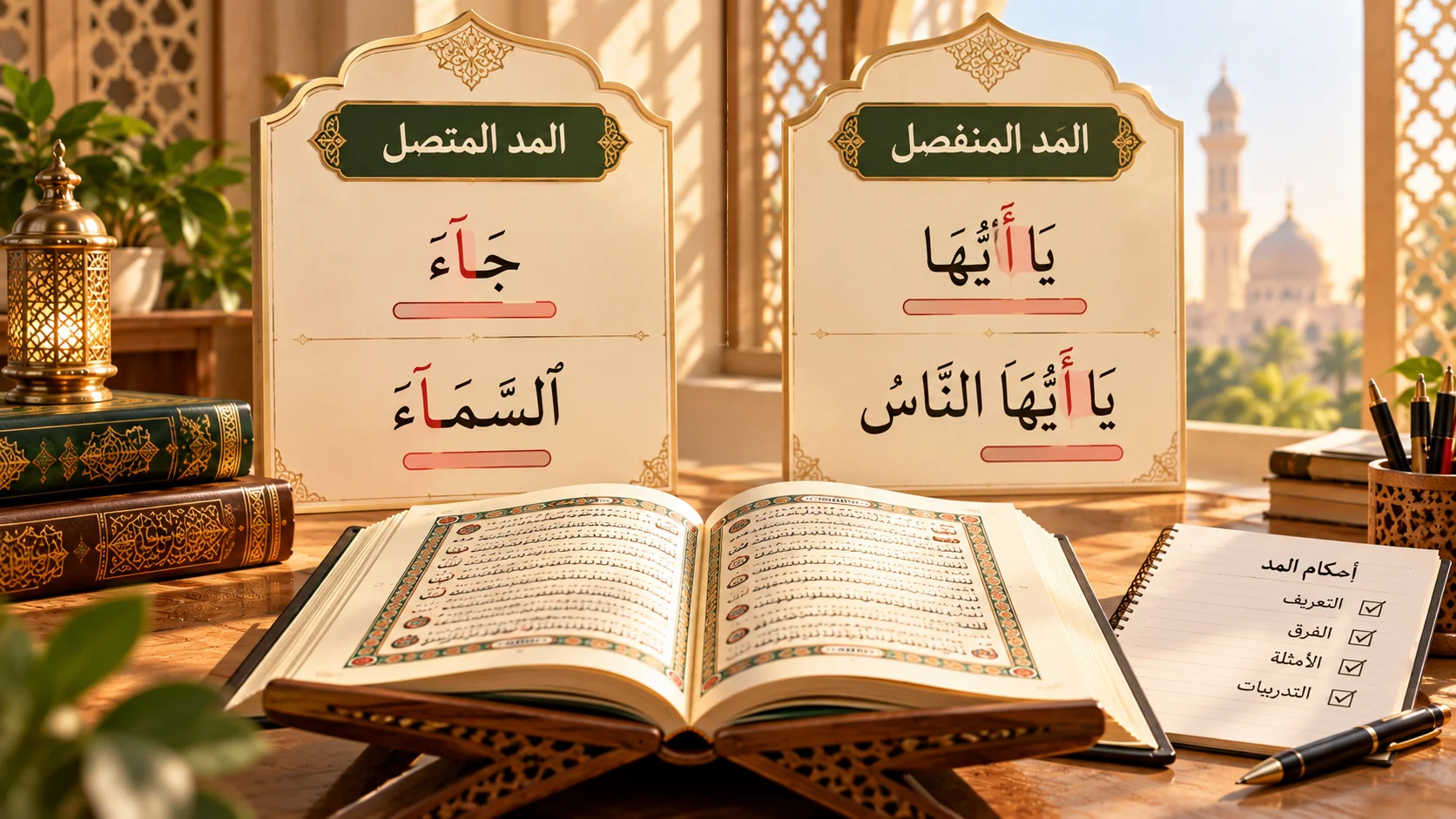
Madd Muttasil has a Madd letter followed by hamzah in the same word. Madd Munfasil has the Madd letter at the end of one word and the following hamzah at the start of the next. Locate the word boundary before deciding which type you are reading.
Start with Tajweed foundations and ask your teacher to check the Madd letters themselves before length practice.
Key Takeaways
- The same-word or next-word boundary distinguishes these two cases.
- The examples use Hafs and an illustrative four-count convention via Shatibiyyah.
- A count is a relative recitation unit, not a fixed number of seconds.
- Listening links do not certify a recording’s transmission route.
Prerequisite: recognizing a Madd letter
The basic long-vowel conditions are an alif preceded by fathah, a sakin waw preceded by dammah, or a sakin ya preceded by kasrah. Recognizing the written letter alone is insufficient; its surrounding vowel matters. Natural Madd is the baseline two-count category when the additional causes under discussion are absent.
The Salsabil al-Shafi commentary, PDF pages 84–86, provides the Madd framework and four/five-count account relevant to these examples. Work within a consistent convention instead of choosing a different count each time.
Compare the categories
| Check | Muttasil | Munfasil |
|---|---|---|
| Position of hamzah | Same word after the Madd letter | Next word after the Madd letter |
| Identification task | Find the Madd and hamzah within one word | Identify the boundary between the words |
| Illustrative convention here | Four counts | Four counts during connection |
| Source example | An-Nasr 110:1 | Al-Kawthar 108:1 |
The four-count choice is a stated teaching illustration for Hafs via Shatibiyyah, not a claim that all valid recitation routes use one length. The cited material also discusses five counts. Do not advertise a two-count munfasil as an interchangeable option in this Shatibiyyah exercise. A teacher should specify the coherent convention and explain other routes when relevant.
Verified source examples
The supplied Tanzil opening lines below include an introductory basmalah before the surah’s first-verse wording. The identification examples concern the wording after that introduction. Text is copied verbatim from Tanzil Project, under its license, with Medina Mushaf/Hafs provenance.
An-Nasr opening, 110:1
بِسْمِ ٱللَّهِ ٱلرَّحْمَٰنِ ٱلرَّحِيمِ إِذَا جَآءَ نَصْرُ ٱللَّهِ وَٱلْفَتْحُ
Locate the word meaning “came.” Its long alif is followed by hamzah within that same word: the selected example is muttasil. Do not classify the entire verse as one Madd category.
Al-Kawthar opening, 108:1
بِسْمِ ٱللَّهِ ٱلرَّحْمَٰنِ ٱلرَّحِيمِ إِنَّآ أَعْطَيْنَٰكَ ٱلْكَوْثَرَ
The long vowel at the end of the opening word is followed by hamzah at the beginning of the next word: during connection, this is the selected munfasil example. Starting or stopping changes the task; ask the teacher to demonstrate an appropriate reading rather than making a pause solely to alter the exercise.
Listen, identify and repeat
Keep the rhythm consistent within the reading. A slower recitation does not make a count equal to a universal clock interval. Avoid timing the vowel with a stopwatch or stretching every long sound to match this pair of rules.
Quiz and answer key
| Question | Your answer |
|---|---|
| Which case keeps Madd and hamzah in one word? | |
| Which selected example crosses a word boundary? | |
| Does a four-count choice mean four seconds? | |
| Does every long sound belong to one of these two categories? |
Answers: muttasil; the connected opening words in 108:1; no; no. Natural Madd and other categories need separate identification.
Teacher-feedback record
| Reference | Type identified | Word boundary located | Convention confirmed | Correction after attempt |
|---|---|---|---|---|
| 110:1 | Muttasil | Same word | ||
| 108:1 | Munfasil | Two words |
Use the Al-Fatihah practice guide for a different verse-based task, and hamzah identification to keep the terms clear. Ask through the Tajweed program for suitable correction.
Editorial ownership: academy editorial team. Quran.com word and verse recordings are provided below. Qualified teacher approval of the pronunciation tasks and the learner’s actual performance remains outstanding.
Listen to the word boundary before practising length
- Open An-Nasr 110:1, enable word-by-word audio and tap جَآءَ. Locate the Madd letter and the following hamzah within that single word.
- Open Al-Kawthar 108:1. Tap إِنَّآ and أَعْطَيْنَـٰكَ separately to locate the end of one word and the hamzah beginning the next.
- Now play 108:1 as a whole verse: separate word playback cannot demonstrate the connected munfasil across that boundary.
- Play 110:1 as a whole verse and point to its same-word example. Classify the selected location, not every long sound in the verse.
- Ask the teacher to check the recording against the article’s illustrative four-count Hafs-via-Shatibiyyah exercise before using its length as a matched model. Selecting Al-Husary does not establish that this particular recording’s route or count has been checked.
- Pause and attempt only the teacher-assigned phrase. Keep counts relative to recitation pace; do not measure them as seconds or alter the convention to copy an unverified recording.
This supplies linked word and verse listening tasks. Qualified review of the specific counted performance remains pending.
Use the players below to listen on this page. Verse recordings are by Mahmoud Khalil Al-Husary, supplied through Quran.com. The separate word clips come from Quran.com’s word-audio service; its metadata does not name the individual reader. Ask your teacher to check your attempt after listening. The Quran.com guide explains the source site’s word and verse controls.
Play the selected word recordings here
| Word and reference | Word recording | Verse recording |
|---|---|---|
| جَآءَ — 110:1 | Listen to the word | Listen to the verse |
| إِنَّآ — 108:1 | Listen to the word | Listen to the verse |
| أَعْطَيْنَـٰكَ — 108:1 | Listen to the word | Listen to the verse |
Audio provided by Quran.com / Quran Foundation. Verse recordings: Mahmoud Khalil Al-Husary, API recitation 6. The word-audio metadata does not identify its individual reader. Playback is part of this learning page under the Developer Terms; no audio file is bundled with downloads.