
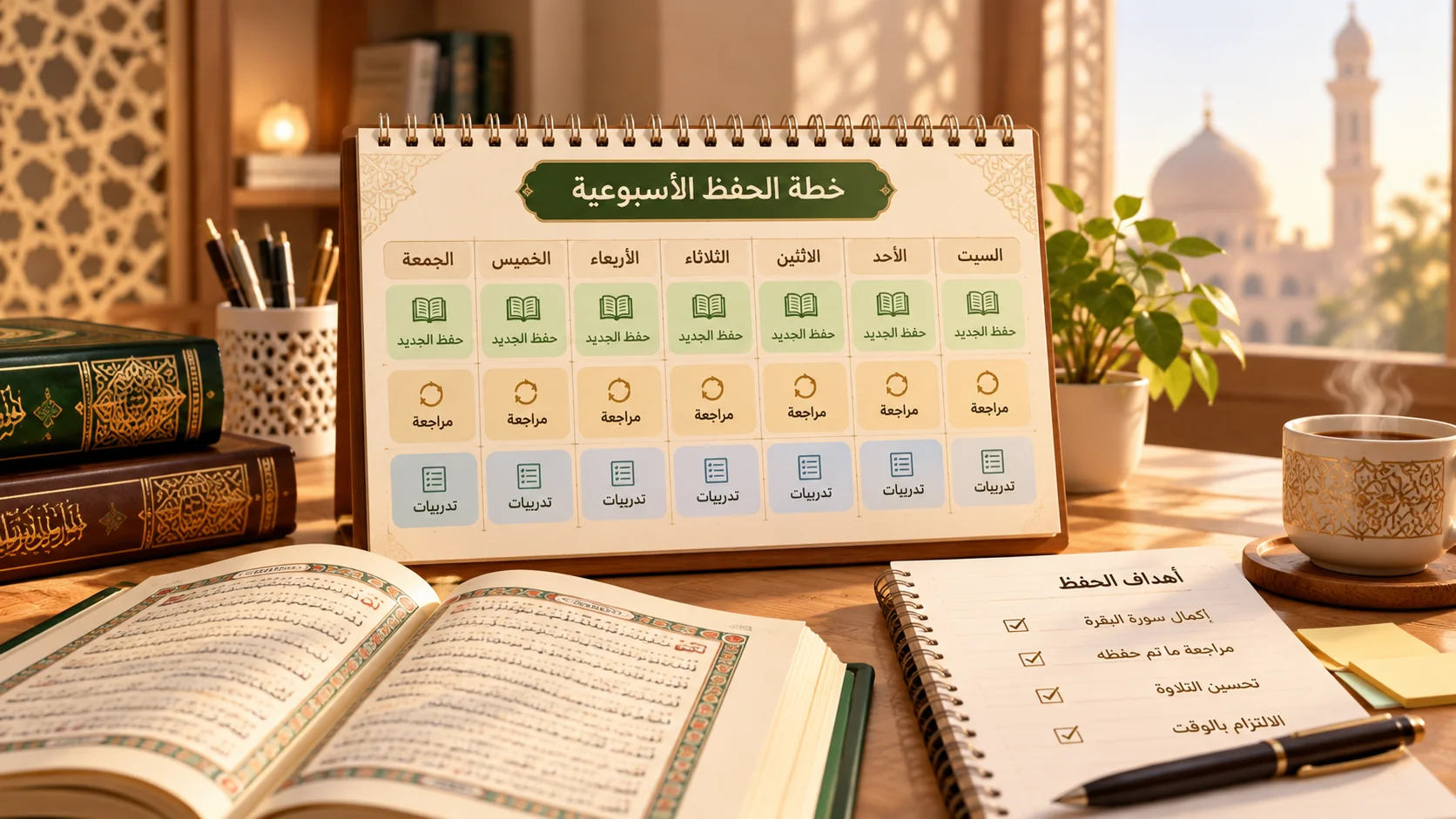
Choose a revision schedule by the material you can currently recall, not the number of pages you once completed. A useful template separates recent work, older retained material and passages needing repair. The memorization routine guide explains the habit; the tables here supply distinct rotations you can copy and edit.
Key Takeaways
- Use one of three templates according to your retained workload.
- Define each review unit before assigning it to a day.
- Keep a repair slot rather than letting errors accumulate.
- The schedules are illustrative and do not guarantee retention.
Define units and choose your starting template
A unit is an amount of previously learned material your teacher considers manageable for one review session. It need not be a page or a complete surah. Write its exact beginning and ending references. Do not split a passage carelessly merely to fill a spreadsheet.
For a small retained set, use template A. For a larger partial set, use B to rotate grouped units while keeping recent work separate. For a substantial retained set, use C only after deciding how many units a review block can contain without losing correction quality. A larger number is not a better schedule if you cannot check errors.
Template A: a small retained set
Label three suitable portions A, B and C, and define them below the table. New learning is optional and should not displace the review.
| Day | Retained portion | Specific repair | Recall check | Next action |
|---|---|---|---|---|
| Monday | A | |||
| Tuesday | B | |||
| Wednesday | C | |||
| Thursday | A | |||
| Friday | B | |||
| Saturday | C | |||
| Sunday | Teacher-selected check |
Unit definitions: A = ___; B = ___; C = ___. If a unit is not yet retained, reduce it and leave the rest as guided reading rather than calling it memorized.
Template B: partial memorization rotation
Divide the older retained material into five manageable groups. Recent work receives a short check each day; it is not counted twice as older work.
| Day | Recent work reference | Older group | Error to repair | Teacher follow-up |
|---|---|---|---|---|
| Monday | Group 1 | |||
| Tuesday | Group 2 | |||
| Wednesday | Group 3 | |||
| Thursday | Group 4 | |||
| Friday | Group 5 | |||
| Saturday | Weakest group | |||
| Sunday | Selected checks |
Group definitions: 1 = ___; 2 = ___; 3 = ___; 4 = ___; 5 = ___. Do not assume all groups need the same time. Adjust the boundaries with the teacher when one group repeatedly overruns its slot.
Template C: a larger retained workload
List all retained units and assign the next unused block each day. When you reach the end, start the rotation again. The blank references make the template usable at different scales; they do not imply a full-Quran weekly cycle.
| Day | Recent review | Older block: start–end | Repair block | Rotation position after session |
|---|---|---|---|---|
| Monday | ||||
| Tuesday | ||||
| Wednesday | ||||
| Thursday | ||||
| Friday | ||||
| Saturday | ||||
| Sunday |
Record the number of defined units: ___. Agree a realistic older-review block: ___. Ask the teacher how recall will be sampled: ___. The rotation may extend beyond one week.
A completed illustrative week
This fictional example uses three short, previously learned surahs for template A. It does not recommend these units for every learner or report real results.
| Day | Portion | Observation | Following action |
|---|---|---|---|
| Monday | Al-Ikhlas | One hesitation | Ask teacher to check the transition |
| Tuesday | Al-Falaq | Needed one prompt | Repeat prompted portion while checking text |
| Wednesday | An-Nas | No self-noticed hesitation | Keep teacher check; self-assessment is limited |
| Thursday | Al-Ikhlas | Same transition uncertain | Reduce task to that transition |
| Friday | Al-Falaq | Prompted portion reviewed | Request an unprompted check |
| Saturday | An-Nas | Review completed | Add specific teacher observation when available |
| Sunday | Selected portions | Two questions recorded | Plan next week’s repair slots |
When to reduce new memorization
Reduce new work if older passages repeatedly need prompts, errors remain unexplained or review slots cannot be completed. Identify the weak portion rather than restarting all material automatically. After a missed day, resume a realistic rotation; doubling everything can obscure the same errors.
Use the working-adult planner for work-related scheduling and the children’s practice guide for family support. Ask through the memorization program about an appropriate workload and assessment.
Editorial ownership: academy editorial team. Templates are original planning aids awaiting qualified teacher sign-off, not a scientifically validated retention protocol.