
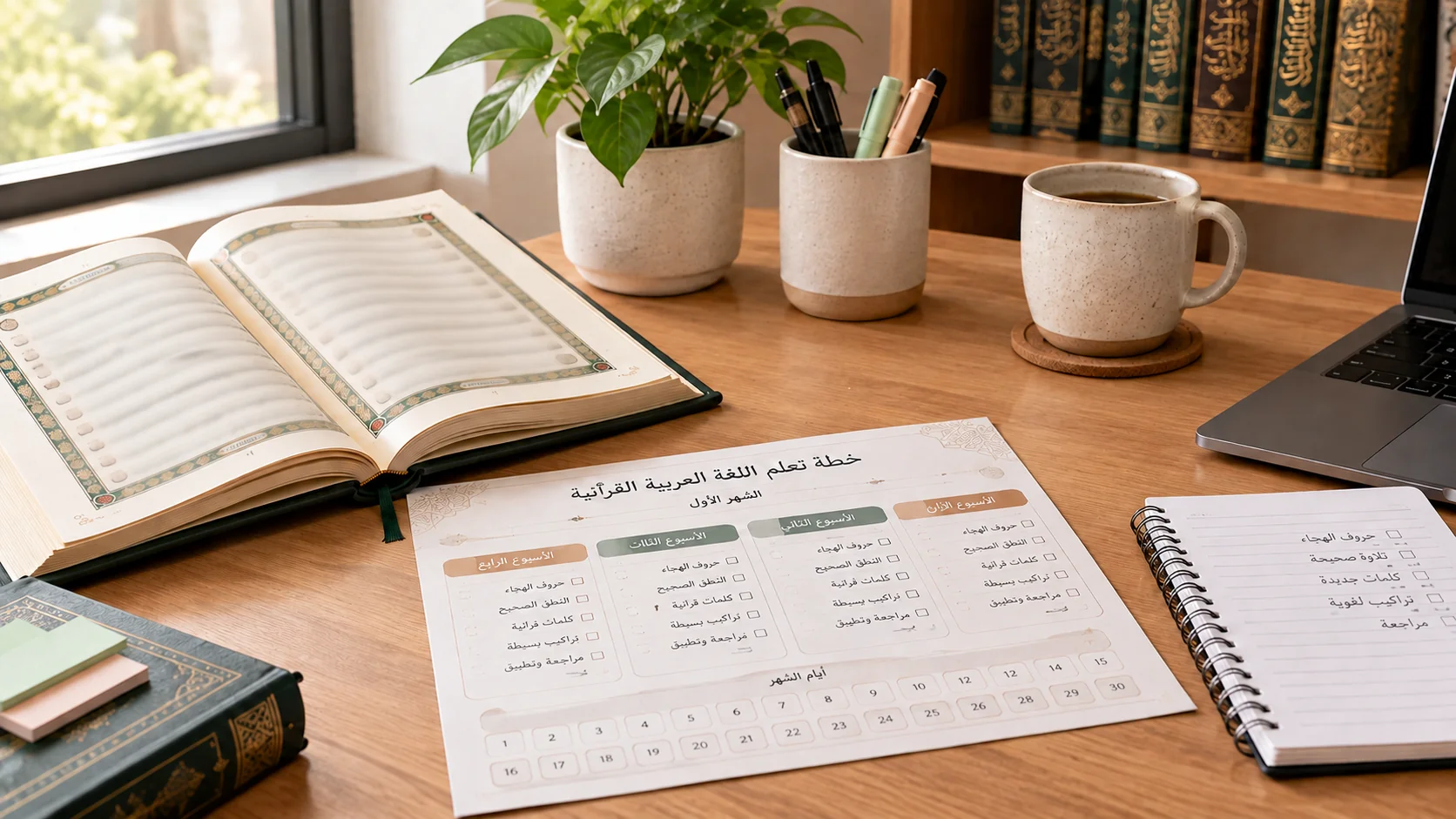
Use the first month to build a small, checked habit of understanding selected Quranic words and phrases. Thirty days is a planning window, not a fluency promise or an official academy syllabus. If you cannot yet read joined letters, begin with reading foundations and adjust the workload.
Key Takeaways
- Assess decoding before adding a meaning workload.
- Study a small vocabulary group in its full verse.
- Examine relationships between words, not isolated translations alone.
- Review uncertainty and teacher questions at the end of each week.
Prepare the workbook
Use an identifiable Mushaf, a notebook and a reliable word-analysis source. The Quranic Arabic Corpus describes its linguistic annotation; a gloss still needs context and does not replace tafsir. The 50-word sheet provides an editable starting set.
Write your starting condition: I can read ___; I need help with ___; my understanding goal is ___. Ask the teacher to confirm a suitable passage. If reading support consumes the available time, extend the calendar rather than rushing the meaning work.
Week 1: vocabulary in one familiar passage
Choose a small group from Al-Fatihah. Read the whole verse, find each target word and check its contextual gloss. Cover the answer and recall it in plain language. Do not require a fixed number of new words each day; repeat uncertainty first.
| Day | Workbook task | Evidence to keep |
|---|---|---|
| 1 | Starting reading and goal check | Note support needed |
| 2 | Select a small verified word group | References and glosses |
| 3 | Locate the words in their verses | Marked notebook references |
| 4 | Cover glosses and attempt recall | Answers before checking |
| 5 | Listen and point to the words | Question about an uncertain word |
| 6 | Review errors in context | Corrected explanation |
| 7 | Summarize the week | Words stable or still uncertain |
Week 2: relationships within a phrase
Use Al-Fatihah 1:5 to distinguish the pronoun and two actions, then 1:6 to notice the request and the described path. Inspect the 1:5 analysis and ask what each word contributes to the phrase. Do not apply an English word order mechanically to Arabic.
| Days | Task | Question for review |
|---|---|---|
| 8–9 | Locate pronoun and actions in 1:5 | Who is addressed? |
| 10–11 | Locate the request in 1:6 | What is being requested? |
| 12–13 | Explain the selected relationships | Which part remains uncertain? |
| 14 | Review without looking at glosses first | Can I explain the limited task accurately? |
Week 3: guided contextual reading
Choose Al-Asr 103:2–3 with teacher guidance. Locate the connecting and exception words, then the listed actions. The goal is to notice how the words organize the statement, not independently derive a theological explanation.
| Days | Task | Workbook output |
|---|---|---|
| 15–16 | Read and identify the selected words | Exact verse references |
| 17–18 | Locate the exception | A plain-language explanation to check |
| 19–20 | Distinguish actions and connecting words | Two examples and questions |
| 21 | Review with source open | Corrected notes |
Week 4: retrieval and a next-step decision
| Days | Task | Check |
|---|---|---|
| 22–23 | Revisit week 1 words | Recall before checking |
| 24–25 | Revisit phrase relationships | Explain only what was studied |
| 26–27 | Revisit the guided passage | Separate certain and uncertain answers |
| 28 | Collect teacher questions | Prioritize recurring uncertainty |
| 29 | Complete the self-check below | Record answers honestly |
| 30 | Agree the next learning step | Continue, reduce or extend the plan |
Self-check with an answer key
- Does sounding out a word prove understanding? No.
- Does a contextual gloss cover every use of a word? No.
- Can this plan certify fluency after thirty days? No.
- What counts as evidence of this month’s work? Checked word meanings, limited phrase explanations, recorded questions and the teacher’s feedback when obtained.
Record which tasks you completed independently and which needed help. A blank day is a reason to adjust the plan, not invent a result. Compare broader goals in Quranic Arabic vs MSA and Egyptian Arabic and ask through the Arabic program about the confirmed reading-foundation or Quranic-Arabic pathway.
Editorial ownership: academy editorial team. This original workbook is illustrative and awaits qualified teacher approval.