
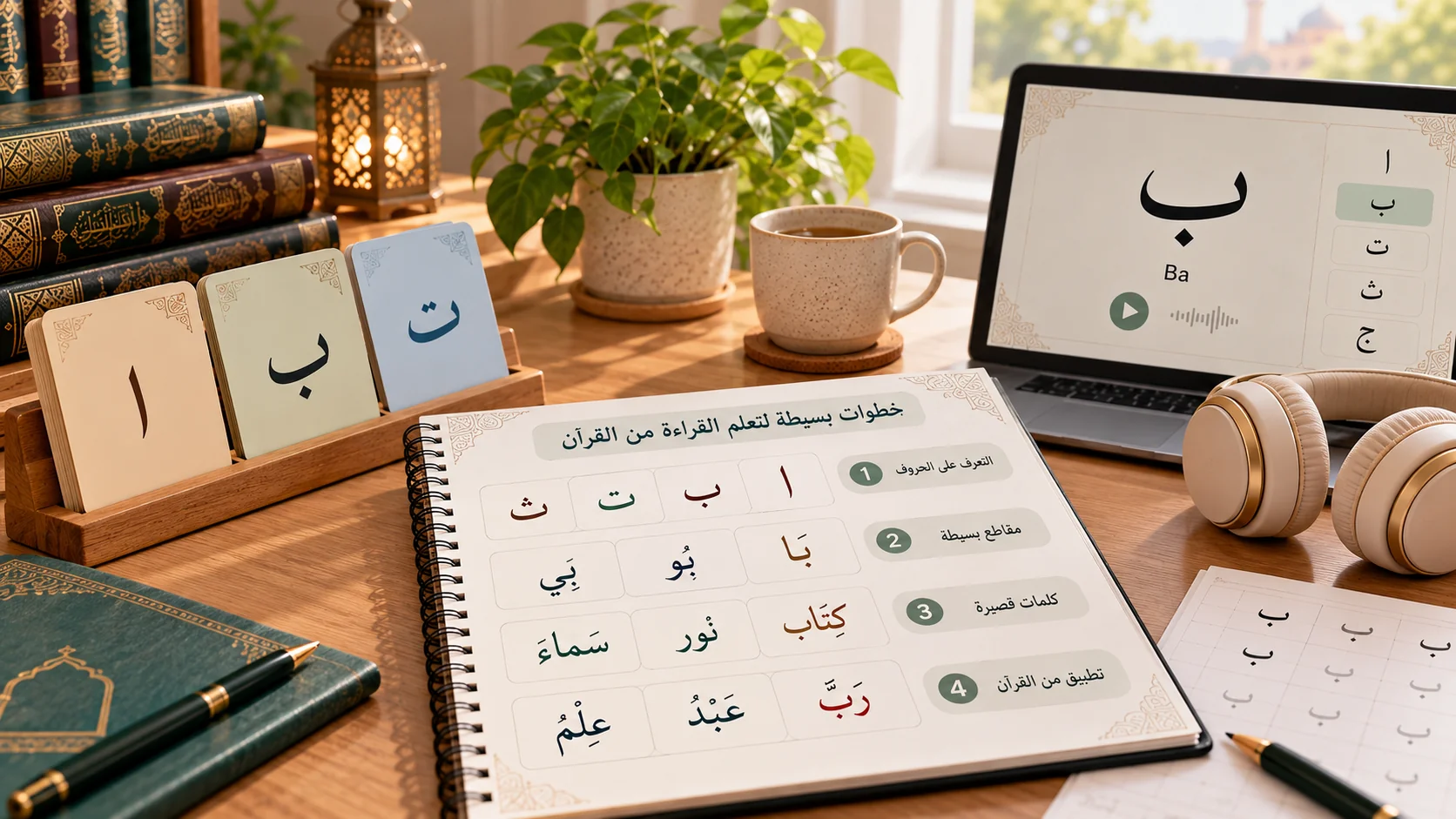
Choose Arabic study according to what you want to do with it. Reading Quranic script, understanding Quranic wording, following contemporary formal Arabic and speaking in everyday Egyptian settings are related but different goals. A course suitable for one task does not automatically cover the others.
The academy’s confirmed Arabic subjects are reading foundations and Quranic Arabic. Use the Arabic program to discuss those goals; this comparison does not offer MSA or Egyptian-dialect courses.
Key Takeaways
- Script reading and understanding are separate skills.
- Quranic Arabic study focuses on Quran vocabulary and constructions.
- MSA and Egyptian Arabic are comparison categories here, not academy offers.
- Shared letters or vocabulary do not make the learning tasks identical.
Define the goal before the course label
In this guide, Quranic Arabic means study of Arabic wording and constructions in the Quran. Modern Standard Arabic, or MSA, means contemporary formal Arabic used in settings such as formal writing. Egyptian Arabic means the Egyptian spoken variety relevant to everyday interaction. These are practical orientation labels, not a complete history or a claim that any category has one uniform learning syllabus.
The Quranic Arabic Corpus documentation illustrates the vocabulary, morphology and syntax needed to investigate Quranic wording. Understanding its analysis requires learning how words function together; recognizing Arabic letters alone is not enough.
The American University in Cairo’s Arabic program FAQ distinguishes contemporary formal MSA from Egyptian Colloquial Arabic for community and everyday use. Cambridge’s Arabic Sociolinguistics excerpt places MSA alongside mainly spoken vernaculars. These sources support the comparison, not an academy course offer.
A goal-to-study comparison
| Your main task | Likely starting focus | What to check before enrolling |
|---|---|---|
| Sound out Quranic text | Reading foundations and recitation feedback | Does the course teach joined letters and reading marks? |
| Understand selected Quran passages | Quranic vocabulary and grammar in context | Are meanings supported and distinguished from full tafsir? |
| Read contemporary formal texts | MSA-oriented reading and vocabulary | Does the actual syllabus cover the texts you need? |
| Hold everyday conversations in Egypt | Egyptian spoken listening and interaction | Does the course actually teach the intended spoken variety? |
The last two rows explain possible goals. They do not describe available academy programs.
See what changes when the task changes
Consider Al-Fatihah 1:5. A reading task asks whether you can pronounce the written passage accurately. A meaning task asks what the verbs and pronoun do in that verse. A grammar task might examine the construction through the verse analysis. A daily conversation lesson would have a different purpose and should not treat Quranic wording as a dialogue script.
The selected Quran vocabulary sheet provides contextual meanings. Those short glosses are not a complete interpretation. For theological or legal conclusions, seek qualified guidance rather than applying a dictionary meaning in isolation.
Shared foundations do not remove the need for a goal
Letter recognition and some vocabulary can support more than one learning path. However, an ability to recognize a Quranic word does not demonstrate conversational listening, and spoken confidence does not demonstrate knowledge of a Quranic construction. Ask what the teacher will assess at the end of a lesson, not merely which label appears on the course page.
If you want multiple goals, put them in order. A learner whose immediate task is reading a short Quran passage might begin with decoding and pronunciation while studying a small vocabulary set. A learner whose immediate task is workplace conversation needs a course that actually covers that use.
Questions for a placement conversation
- Can I read joined Arabic letters and common marks independently?
- Is my goal pronunciation, understanding, conversation or more than one?
- Which goal comes first in the available study time?
- What examples and assessments will the course use?
- What subjects are outside the provider’s actual offer?
Use Arabic letters to Quran reading for the first check and the first-month Quranic Arabic plan for an illustrative understanding pathway.
Editorial ownership: academy editorial team. The goal comparison is educational orientation; a complete comparative-linguistics review and qualified teacher endorsement remain outstanding.